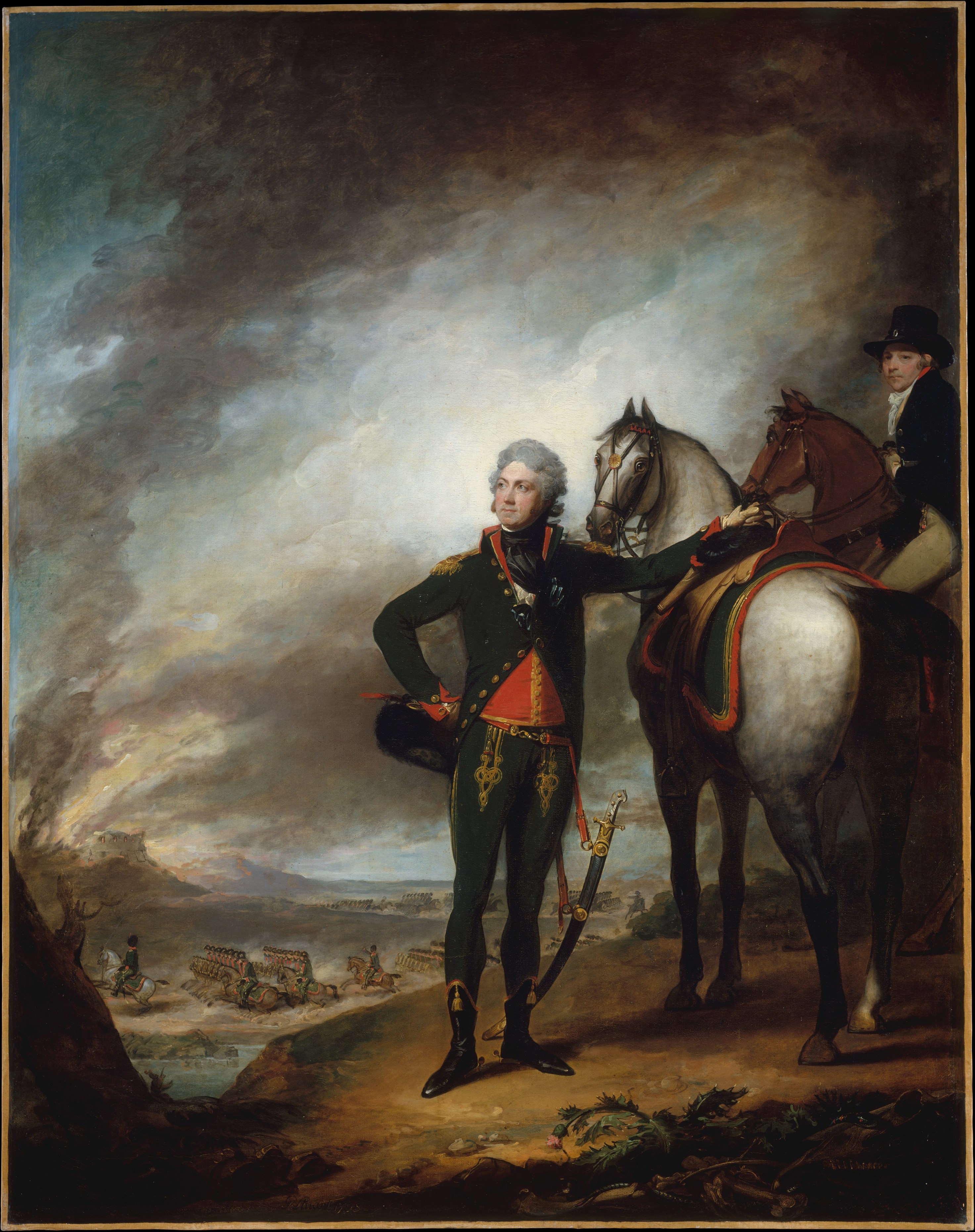

Pull up a chair, let’s talk history.
On January 7, 1804, Louis-Marie, Viscount de Noailles, died in Havana from wounds suffered while capturing a British vessel. Six days earlier, Haitian leaders had declared independence from France. Noailles had spent his final months trying to prevent that outcome.
His death brought an extraordinary career to a close. As a young French officer, he fought for American independence and helped negotiate the British surrender at Yorktown. In 1789, he helped the French National Assembly dismantle aristocratic privilege. In Saint-Domingue, he served an expedition sent by Napoleon Bonaparte to restore French authority over a population determined to preserve emancipation.
That career does not fit neatly within the usual story of revolutionary liberty. It is useful for precisely that reason.
Serena Jampel reconstructs Noailles’ life in a recent Smithsonian article, “The Marquis de Lafayette’s Brother-in-Law Participated in Three Revolutionary Wars, Supporting American Independence but Brutally Suppressing an Uprising by Enslaved Africans in Haiti.” Her central question concerns the meaning and limits of revolutionary principle. How could an officer support independence in one setting, surrender privilege in another, and then participate in a campaign against Black independence?[1]
The answer begins with the world in which Noailles learned to understand liberty.
Born in Paris in 1756, Noailles belonged to one of France’s most prominent noble families. He married Anne Jeanne Baptiste de Noailles in 1773. Her younger sister Adrienne married the Marquis de Lafayette the following year, making the two officers brothers-in-law.[2]
The American Revolution appealed to young French aristocrats for several reasons. It offered military distinction, an opportunity to weaken Britain, and a chance to associate themselves with Enlightenment arguments about constitutional government. Lafayette reached America in 1777. Noailles entered French service the next year, after France formally joined the war.
Noailles first distinguished himself in the Caribbean. He later participated in the unsuccessful Franco-American siege of Savannah in 1779. That battle already revealed the international character of the conflict. French forces included free men of color from Saint-Domingue. Some of those soldiers later became associated with the Haitian Revolution, although the surviving evidence does not permit us to assign all of them a common political purpose in 1779.[3]

That caution matters. Men could fight in the same formation without attaching the same meaning to the war. Noailles sought military honor and American independence. The free men of color from Saint-Domingue occupied a colonial society structured by slavery and racial hierarchy. Their reasons for enlisting arose from their own circumstances.
Noailles’ most important American service came at Yorktown in October 1781. French naval power blocked British escape by sea while American and French troops tightened the siege. When Lord Cornwallis requested negotiations, George Washington appointed John Laurens to represent the Americans. The French selected Noailles. Together, Laurens and Noailles negotiated the articles that governed the British surrender.[4]

Alexander Hamilton’s correspondence shows the esteem Noailles earned. Writing in 1782, Hamilton praised his talents and character and hoped that he might return to America if the war continued. Hamilton also admitted that another campaign would depend upon French military and financial support. His letter joined personal affection to a sober description of American dependence upon France.[5]
Noailles returned home with the reputation of a successful officer. The French Revolution then gave him a different kind of opportunity.
In the summer of 1789, France faced political breakdown, fiscal crisis, and widespread rural unrest. On the night of August 4, deputies in the National Assembly renounced a broad range of seigneurial and provincial privileges. Noailles helped initiate the session. The resulting decrees announced the abolition of the feudal system, ended exclusive hunting rights and seigneurial courts, abolished many offices and privileges, and declared citizens equally liable for taxation.[6]
For a nobleman to support those measures required him to surrender inherited advantages. Noailles was not merely repeating pleasant language about liberty. He participated in legislation that weakened the legal structure sustaining his own social rank.

The boundaries of the reform were nevertheless visible. The August decrees addressed hierarchy within metropolitan France. They did not abolish colonial slavery. The National Assembly included men with direct interests in the colonies, and proposals concerning slavery did not produce comparable action that night.
Now, it is worth pausing here. That omission should not be explained solely as personal inconsistency. French revolutionaries disputed who qualified for political rights, how colonial representation should work, and whether universal claims applied across the empire. Saint-Domingue was France’s most profitable colony. Its plantations depended upon the forced labor of enslaved Africans and their descendants. Economic power and racial ideology protected that system.
Noailles could therefore challenge noble privilege while leaving colonial slavery largely outside his reform program. His understanding of liberty was real, but it was bounded by the political community he had in mind.
The French Revolution eventually turned against men like him. Royalists regarded liberal nobles as traitors to their order. Radicals distrusted their titles, wealth, and military authority. Noailles left France in 1792. His wife and father were executed during the Terror in 1794.[7]
The United States became his refuge. He renewed friendships with American leaders, entered business, and became an American citizen in 1795. He had helped establish the republic as a soldier, and the republic now gave him a place to rebuild his life.
His decision to return to French military service several years later remains difficult to explain with certainty. By 1802, Bonaparte had sent a major expedition to Saint-Domingue. The colony had been in revolution since an uprising of enslaved people began in 1791. Revolutionary commissioners abolished slavery there in 1793, and the French government extended abolition across the empire in 1794.
Bonaparte’s expedition sought to reassert control. French forces had already restored slavery in Guadeloupe, giving the people of Saint-Domingue good reason to believe that their freedom was in danger. Resistance became a war for independence.
Noailles accepted command at Môle Saint-Nicolas. He served under Donatien de Rochambeau, whose campaign relied upon terror as French authority collapsed. Noailles traveled to Cuba to obtain dogs for use against Black combatants. Contemporary accounts connect the expedition to a public demonstration in which dogs killed an enslaved boy. Jampel includes this episode because it belongs to the history, not because it can be reconciled with Noailles’ earlier reputation.[8]
It cannot.

We should still distinguish explanation from excuse. Noailles appears to have understood military service as an obligation to France. Historian Marlene Daut puts the point directly in Jampel’s article: he fought where France fought because he was a soldier and believed in France.[9] National loyalty helps explain the continuity in his conduct. It also exposes the limits of his revolutionary commitments.
In America, Noailles fought against British imperial authority. In France, he attacked legal privilege within the nation. In Saint-Domingue, he defended French imperial authority against people who connected independence directly to freedom from slavery. The word liberty remained in circulation, but the claimant changed.
The French expedition failed. Disease devastated its forces, British naval pressure restricted supply and escape, and Haitian armies defeated the remaining French troops. A scholarly study of the expedition estimates that tens of thousands of French soldiers and sailors died. Môle Saint-Nicolas was among the last French positions to fall. Noailles escaped toward Cuba in December 1803 but received fatal wounds during a final naval action.[10]
On January 1, 1804, Haiti declared independence. Its declaration joined national sovereignty to the permanent defeat of slavery. As historian Julia Gaffield explains, Haitian leaders did not simply imitate the American Declaration. They produced a document fitted to a revolution in which political independence was necessary to prevent re-enslavement.[11]

That distinction gives Noailles’ biography its historical weight. The American and French Revolutions helped expand arguments about rights and sovereignty, but they did not settle who possessed those rights. Haitian revolutionaries pressed the matter further by insisting that emancipation could not remain secure under the authority of a slaveholding empire.
Noailles should not be reduced to a hero who lost his way, nor to a villain whose earlier principles were always fraudulent. Both conclusions flatten the evidence. His choices show how revolutionary commitments operated within loyalties to nation, class, empire, and military profession. Those loyalties could reinforce liberty in one setting and place him against it in another.
For future research, I would compare three documents attached to his career: Hamilton’s 1782 letter praising his service, the August 1789 decrees abolishing privilege, and the Haitian Declaration of Independence. Each document defines a political community and identifies a form of domination that must end. Reading them together would make the differences difficult to miss.
Hamilton saw Noailles as a valuable friend of American independence. The National Assembly treated seigneurial privilege as incompatible with citizenship. Haitian leaders regarded continued French rule as a threat to emancipation itself. Noailles stood near all three claims, but he did not apply them in the same way.
That is not a tidy conclusion. Revolutions rarely offer one. They open political possibilities while preserving older boundaries, and people who speak convincingly for liberty may still resist its extension beyond the community they recognize as their own. Noailles’ life allows us to watch that boundary move across three revolutions.
Until next time,
Bibliography
French National Assembly. “4 August Decrees.” August 4, 1789. Translated by Exploring the French Revolution project staff. Liberty, Equality, Fraternity: Exploring the French Revolution. George Mason University. Accessed October 6, 2026. https://revolution.chnm.org/d/366.
Gaffield, Julia. “The Declaration around the World: Haiti.” Museum of the American Revolution. January 22, 2026. https://www.amrevmuseum.org/the-declaration-around-the-world-haiti.
Girard, Philippe R. “The Ugly Duckling: The French Navy and the Saint-Domingue Expedition, 1801-1803.” International Journal of Naval History. https://ijnh.seahistory.org/the-ugly-duckling-the-french-navy-and-the-saint-domingue-expedition1801-1803/.
Hamilton, Alexander. Letter to Vicomte de Noailles, [April-June 1782]. Founders Online, National Archives. https://founders.archives.gov/documents/Hamilton/01-03-02-0018.
Jampel, Serena. “The Marquis de Lafayette’s Brother-in-Law Participated in Three Revolutionary Wars, Supporting American Independence but Brutally Suppressing an Uprising by Enslaved Africans in Haiti.” Smithsonian, October 1, 2026. https://www.smithsonianmag.com/history/the-marquis-de-lafayettes-brother-in-law-participated-in-three-revolutionary-wars-supporting-american-independence-but-brutally-suppressing-an-uprising-by-enslaved-africans-in-haiti-180989582/.
National Park Service. “Charles Cornwallis.” Last modified March 12, 2025. https://www.nps.gov/people/charles-cornwallis.htm.
[1]Serena Jampel, “The Marquis de Lafayette’s Brother-in-Law Participated in Three Revolutionary Wars, Supporting American Independence but Brutally Suppressing an Uprising by Enslaved Africans in Haiti,” Smithsonian, October 1, 2026, https://www.smithsonianmag.com/history/the-marquis-de-lafayettes-brother-in-law-participated-in-three-revolutionary-wars-supporting-american-independence-but-brutally-suppressing-an-uprising-by-enslaved-africans-in-haiti-180989582/.
[2]Jampel, “Marquis de Lafayette’s Brother-in-Law.”
[3]Jampel, “Marquis de Lafayette’s Brother-in-Law.”
[4]“Charles Cornwallis,” National Park Service, last modified March 12, 2025, https://www.nps.gov/people/charles-cornwallis.htm; Jampel, “Marquis de Lafayette’s Brother-in-Law.”
[5]Alexander Hamilton to Vicomte de Noailles, [April-June 1782], Founders Online, National Archives, https://founders.archives.gov/documents/Hamilton/01-03-02-0018.
[6]Jampel, “Marquis de Lafayette’s Brother-in-Law”; French National Assembly, “4 August Decrees,” August 4, 1789, trans. Exploring the French Revolution project staff, Liberty, Equality, Fraternity: Exploring the French Revolution, George Mason University, accessed October 6, 2026, https://revolution.chnm.org/d/366.
[7]Jampel, “Marquis de Lafayette’s Brother-in-Law.”
[8]Jampel, “Marquis de Lafayette’s Brother-in-Law.”
[9]Marlene Daut, quoted in Jampel, “Marquis de Lafayette’s Brother-in-Law.”
[10]Philippe R. Girard, “The Ugly Duckling: The French Navy and the Saint-Domingue Expedition, 1801-1803,” International Journal of Naval History, https://ijnh.seahistory.org/the-ugly-duckling-the-french-navy-and-the-saint-domingue-expedition1801-1803/; Jampel, “Marquis de Lafayette’s Brother-in-Law.”
[11]Julia Gaffield, “The Declaration around the World: Haiti,” Museum of the American Revolution, January 22, 2026, https://www.amrevmuseum.org/the-declaration-around-the-world-haiti.
Image bibliography
1. Campbell, Archibald, attributed. Plan of the Siege of Savannah, with the Joint Attack of the French and Americans on the 9th October, 1779. Historical map. Bibliothèque nationale de France. Wikimedia Commons.
2. Frilley, Jean-Jacques, after Auguste Raffet. Combats entre les insurgés de Saint-Domingue et les troupes françaises envoyées par Napoléon Bonaparte (1802–1803). Engraving, nineteenth century. Archives territoriales de Martinique. Wikimedia Commons.
3. Helman, Isidore-Stanislas, after Charles Monnet. Assemblée Nationale, abandon de tous les privilèges, à Versailles, séance de la nuit du 4 au 5 août 1789. Engraving, 1790. Musée Carnavalet, Paris. Paris Musées.
4. Haitian Declaration of Independence. Printed document, January 1, 1804. The National Archives, United Kingdom, MFQ 1/184. Wikimedia Commons.
5. Stuart, Gilbert. Louis-Marie, Vicomte de Noailles. Oil on canvas, 1798. The Metropolitan Museum of Art, New York. Accession no. 1970.262. Metropolitan Museum of Art.
6. Trumbull, John. Surrender of Lord Cornwallis. Oil on canvas, 1820. United States Capitol Rotunda, Washington, DC. Wikimedia Commons.


Leave a Reply